A 'Family Farm Tour' in Western North Carolina (organized by the Appalachian Sustainable Agriculture Project) was a rewarding way to spend some time this weekend. ASAP works to keep farmers farming and reconnect people with their food and is a wonderful regional support for small farm operations and promoting eating food grown locally.
I've trying to learn a lot more about where the food we (my gardening companion and I) eat comes from and how it's produced (beyond what I grow) and it's a fascinating pursuit - and extremely humbling and not always pleasant.
Are we as American consumers ready to pay for sustainably and humanely produced food?
Currently, I'm afraid the answer is probably no (based on my question to my gardening companion about chicken $6 for an organically raised, free-range bird vs a $3 mass-produced broiler - but he's not the cook and food buyer in our family).
My answer is yes.
Sunday, June 28, 2009
Friday, June 26, 2009
Eastern Cottontail rabbit habitat
In our garden, currently, 'our' rabbit hangs out here.
But all of the young okra seedlings, and a number of squash leaves in the satellite garden disappeared yesterday evening, so I don't know whether to think 'rabbit' or 'young woodchuck.'
Oh, well, we don't much care for okra (it was an experiment) and unless the squash vine borers hurry up (there have been a few casualties already), we'll have more squash than we can eat.
We're fortunate (and I'm grateful) to have plenty of space to spread out herbivore impact.
Probably the mama woodchuck will come up from the woodpile and eat all of the squash vines while we're up in the mountains this weekend and I won't sound so positive!
But all of the young okra seedlings, and a number of squash leaves in the satellite garden disappeared yesterday evening, so I don't know whether to think 'rabbit' or 'young woodchuck.'
Oh, well, we don't much care for okra (it was an experiment) and unless the squash vine borers hurry up (there have been a few casualties already), we'll have more squash than we can eat.
We're fortunate (and I'm grateful) to have plenty of space to spread out herbivore impact.
Probably the mama woodchuck will come up from the woodpile and eat all of the squash vines while we're up in the mountains this weekend and I won't sound so positive!
Thursday, June 25, 2009
Becoming a better gardener
I'm thinking again about what you really need to know to become a better gardener (and maybe what I mean is a good garden steward). I love learning more about plants and gardening (that's what makes it fun) and the images with Thomas Jefferson's quote at the end of my wildlife gardening talks reflect that (hmm, notice the rabbit!)

I mused about this some months ago, largely because one of our local extension offices was offering a class for the public on 'home horticulture' that was a less-intensive version of our SC Master Gardener program.
But I had a significant 'stirring-the-pot' experience this morning looking over Ann Lovejoy's excellent book 'Organic Garden Design School' -- she wonderfully describes what my gardening companion and I have bumbled into doing in our formerly large grassy expanse.
We've created our garden landscape not from a horticultural perspective but an ecological one, and our garden landscape has been inspired by admiration of natural landscapes and a keen interest in mimicking their best attributes. Lovejoy writes about creating successful gardens by understanding what thrives there (a mix of natives and well-adapted non-natives), and not trying to grow plants that won't. There's a significant European gardening trend to mimic natural landscapes (from all over the world) to create sustainable garden designs. A fabulous city garden landscape (the Lurie Garden) in Chicago was envisioned by a Dutch garden designer (Piet Oudolf) based on North American prairie landscapes.
So, what we know about plant life histories, reproductive strategies, plant adaptations, pollinator behavior, native plant communities, as well as all sorts of stuff about botany in general (from many years of study) has actually been the underpinning to a home garden that pleases us a great deal.
So, I'm trying to think again about what is it that someone really needs to know to become a better gardener as I think about how best I can encourage folks in our Garden classes to learn about plants and gardening.
I'm coming back to the idea that it's really about understanding plants, where they come from (that is, what part of the world and what sort of habitat), why you're growing them, and whether they're suited to where you want to grow them. Vegetables need something quite different than prairie wildflowers like purple coneflower (Echinacea), rattlesnake master (Eryngium), and blazing star (Liatris), but it's still about learning about plants.
I'd welcome your thoughts!

I mused about this some months ago, largely because one of our local extension offices was offering a class for the public on 'home horticulture' that was a less-intensive version of our SC Master Gardener program.
But I had a significant 'stirring-the-pot' experience this morning looking over Ann Lovejoy's excellent book 'Organic Garden Design School' -- she wonderfully describes what my gardening companion and I have bumbled into doing in our formerly large grassy expanse.
We've created our garden landscape not from a horticultural perspective but an ecological one, and our garden landscape has been inspired by admiration of natural landscapes and a keen interest in mimicking their best attributes. Lovejoy writes about creating successful gardens by understanding what thrives there (a mix of natives and well-adapted non-natives), and not trying to grow plants that won't. There's a significant European gardening trend to mimic natural landscapes (from all over the world) to create sustainable garden designs. A fabulous city garden landscape (the Lurie Garden) in Chicago was envisioned by a Dutch garden designer (Piet Oudolf) based on North American prairie landscapes.
So, what we know about plant life histories, reproductive strategies, plant adaptations, pollinator behavior, native plant communities, as well as all sorts of stuff about botany in general (from many years of study) has actually been the underpinning to a home garden that pleases us a great deal.
So, I'm trying to think again about what is it that someone really needs to know to become a better gardener as I think about how best I can encourage folks in our Garden classes to learn about plants and gardening.
I'm coming back to the idea that it's really about understanding plants, where they come from (that is, what part of the world and what sort of habitat), why you're growing them, and whether they're suited to where you want to grow them. Vegetables need something quite different than prairie wildflowers like purple coneflower (Echinacea), rattlesnake master (Eryngium), and blazing star (Liatris), but it's still about learning about plants.
I'd welcome your thoughts!
Wednesday, June 24, 2009
Eastern Cottontail rabbit
I have a special fondness for rabbits. Probably if we had more of them, and they were a nuisance in my vegetable garden, I wouldn't think so favorably about them. We live in a small town that's quite suburban in character, really; although we're not in the 'suburbs,' we're not totally rural anymore, either. There's plenty of open space here, but it's increasingly punctated by a mix of houses, pop-up malls, etc.Rabbits are a scarce commodity around here. I always enjoy spotting one on a morning walk or in our garden.
Growing up, I loved The Story of Peter Rabbit and all of the other Beatrix Potter tales. My mom even gave me a collection of Beatrix Potter stories as a keepsake as a young adult.
So I was delighted to see this large rabbit in the front meadow this morning. S/he was nibbling on grasses, and looks like quite the robust specimen.
Tuesday, June 23, 2009
Evening sounds
Southern evenings, especially in the transition from day to dusk to night, are filled with sound; cicadas and day-singing crickets give way to evening-singing crickets, katydids, and tree frogs. I love the nocturnal symphony.
Distinguishing between them takes some study. I've been working on it for awhile (although perhaps not diligently enough!) Lang Elliot's The Sounds of Insects is loaded on the main iPod, but I need to put it on the small one that I take walking or when I'm in the garden. It's not the first thing I'd think about listening to, though, I'm afraid. There's definitely an instructive aspect to trying to listen to sequences of insect calls that isn't that appealing, but maybe it's just a new language to learn.
I just had to look up whether it was cicadas or katydids that called during the day (they have similar loud raspy calls), but I'm beginning to be able to hear the differences between tree frogs and the different species of crickets (hmm). There are so many things to have fun learning about, sometimes I think I get almost distracted with the possibilities.
Distinguishing between them takes some study. I've been working on it for awhile (although perhaps not diligently enough!) Lang Elliot's The Sounds of Insects is loaded on the main iPod, but I need to put it on the small one that I take walking or when I'm in the garden. It's not the first thing I'd think about listening to, though, I'm afraid. There's definitely an instructive aspect to trying to listen to sequences of insect calls that isn't that appealing, but maybe it's just a new language to learn.
I just had to look up whether it was cicadas or katydids that called during the day (they have similar loud raspy calls), but I'm beginning to be able to hear the differences between tree frogs and the different species of crickets (hmm). There are so many things to have fun learning about, sometimes I think I get almost distracted with the possibilities.
Monday, June 22, 2009
A sedum garden
Sedums are one of my favorite groups of drought tolerant plants. I like to use the
m in window boxes and containers, where they thrive with minimal care. They also have a tremendous diversity of habits, color, and form within the large numbers of species available, although with much cultivar diversity.I was admiring a green roof display at a mountain nursery a couple of weeks ago, and took my gardening companion back to look at some other plants (thinking that he'd enjoy the sedums, too).

They were exceptionally attractive (happily, he doesn't need much encouragement) and we set about adding a small sedum garden in the dry mulched area above the bog-in-progress.
We even went back the next day to get more to add, along with a few with some height.
We're hoping that they'll thrive with minimal care!
Our gardening assistant (perhaps I should say 'supervisor') seems to approve.
Labels:
drought-tolerant plants,
natural gardening,
Sedums
Saturday, June 20, 2009
A bumblebee visit
One of my favorite warm-season garden activities is watching flower visitors. Bumblebees, carpenter bees, squash bees, blueberry bees, leaf-cutter bees, honeybees, butterflies, wasps, hoverflies, sweatbees, and hummingbirds collect either nectar or pollen or both.

I can't imagine why I ever (as a clueless graduate student) thought that this wasn't interesting, preferring the germination strategies of weedy species (hmm, at least that turned out to be useful).
But as a gardener, and garden educator, I've had SO much fun observing flower visitors, and encouraging other folks to watch.

This morning, a (female) bumblebee was foraging on one of the purple coneflowers in the front meadow, busily working through the fresh young flowers that make up the 'head' of a composite, collecting pollen (note her pollen basket) as well as nectar. I had to check with my gardening companion (uh, he studied pollination biology in graduate school) about their foraging habits!

I can't imagine why I ever (as a clueless graduate student) thought that this wasn't interesting, preferring the germination strategies of weedy species (hmm, at least that turned out to be useful).
But as a gardener, and garden educator, I've had SO much fun observing flower visitors, and encouraging other folks to watch.

This morning, a (female) bumblebee was foraging on one of the purple coneflowers in the front meadow, busily working through the fresh young flowers that make up the 'head' of a composite, collecting pollen (note her pollen basket) as well as nectar. I had to check with my gardening companion (uh, he studied pollination biology in graduate school) about their foraging habits!
Labels:
bumblebee,
bumblebees,
Echinacea,
flo,
natural gardening,
purple coneflower
Friday, June 19, 2009
Echinacea and borders
This has been such a wonderful spring for gardening (in the SE U.S.) After 10 years of drought, plants are responding to abundant spring rains with abandon.
Our garden looks great, compared to what it's looked like in recent years. And my tomatoes, beans, squash and other summer vegetables are robust beyond anything that I've had before, since I started growing vegetables in earnest ~10 years ago.
This volunteer purple coneflower (Echinacea purpurea) is huge and the meadow is looking robust.
And the side border is looking as nice as it ever has.
I've been so grateful for the rain, and it's heightened our appreciation of our garden landscape.
Our gardening assistant (Mocha) likes being at home, too.
Our garden looks great, compared to what it's looked like in recent years. And my tomatoes, beans, squash and other summer vegetables are robust beyond anything that I've had before, since I started growing vegetables in earnest ~10 years ago.This volunteer purple coneflower (Echinacea purpurea) is huge and the meadow is looking robust.
And the side border is looking as nice as it ever has.
I've been so grateful for the rain, and it's heightened our appreciation of our garden landscape.
Our gardening assistant (Mocha) likes being at home, too.
Labels:
abundant rain,
Echinacea,
natural gardening,
purple coneflower
Thursday, June 18, 2009
Time to plant
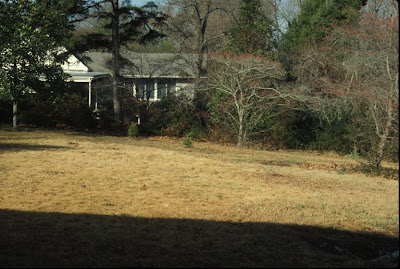
I always encourage new gardeners to just start planting. It doesn't take long to create a transformation. We're not brilliant gardeners -- admittedly, we do know about the ecology of native plants, so our design ideas come from inspiration from nature.Plant trees first, then shrubs, and then perennials, creating a landscape to enjoy. We no longer see our neighbor's house at all (the angle is slightly different, but the idea is there).
From this, to this.

This was 15 years of growth, but by 8 years, we didn't see our front street.

Wednesday, June 17, 2009
Squirrels! Hrmmph!
Sitting at my computer this morning, a furry blur caught my eye. On top of one of the feeders. One with a squirrel baffle. Hhrmph. I took a closer look.
But, it was hard to be too annoyed. This rascal had suspended him/herself from the top of the feeder and was munching away. Quite amazing.I have no idea how it had managed to get there -- maybe leapfrogging across the tops of the other feeders from the nearby dogwood? My gardening companion thinks that it probably leaped down from the big Southern red oak -- this feeder used to be in the open, but things are growing well this year.
I mean, really -- this squirrel was dangling there for ages chowing down, before I went outside and it nimbly scampered up the thistle feeder to leap into the dogwood.
Tuesday, June 16, 2009
Lots of things to reflect on
This is a time of year that bursts with observation and activity.
There are so many things to reflect on -- the first blueberries harvested (huge), the first pole beans, Ronde de Nice squash almost ready to harvest as 'baby' squash, and tomato and cucumber plants growing like the vines they are. Thank goodness for a normal rainfall spring. It makes a HUGE difference after the decade-long drought that we've had. The front meadow is lovely, as is the side border.
Coming home from the mountains, it's nice to see a green landscape, instead of a parched one. But even with that, it's always revealing to see how the containers and window boxes have managed for several days, even planted with drought-tolerant plants.
We're expecting 96° F afternoon temperatures by the end of the week. Bleech. Soft young leaves encouraged by abundant rain will need to toughen up!
There are so many things to reflect on -- the first blueberries harvested (huge), the first pole beans, Ronde de Nice squash almost ready to harvest as 'baby' squash, and tomato and cucumber plants growing like the vines they are. Thank goodness for a normal rainfall spring. It makes a HUGE difference after the decade-long drought that we've had. The front meadow is lovely, as is the side border.
Coming home from the mountains, it's nice to see a green landscape, instead of a parched one. But even with that, it's always revealing to see how the containers and window boxes have managed for several days, even planted with drought-tolerant plants.
We're expecting 96° F afternoon temperatures by the end of the week. Bleech. Soft young leaves encouraged by abundant rain will need to toughen up!
Labels:
natural gardening,
spring rains,
summer drought,
summer heat
Sunday, June 14, 2009
Bird feeders
In my non-wildlife gardening days, I figured birds were on their own. There's generally plenty of food out there, I thought, although habitat might be in short supply.
But putting out bird feeders (sunflower seed, thistle seed, and suet) some years ago opened a new arena of observation.
All of the usual suspects (speaking in 'now' terms) appeared -- and they're great -- I know all the songs and call of our regular garden birds, and whether they eat seeds or suet, or kick up insects in the leaf litter or eat earthworms in the spring.
In the mountains, we added all of these, and it didn't take long for the seeds to be discovered. There was a parade of cardinals, tufted titmice, and Carolina chickadees at the sunflower seed feeder, and this male goldfinch loaded up.
But putting out bird feeders (sunflower seed, thistle seed, and suet) some years ago opened a new arena of observation.
All of the usual suspects (speaking in 'now' terms) appeared -- and they're great -- I know all the songs and call of our regular garden birds, and whether they eat seeds or suet, or kick up insects in the leaf litter or eat earthworms in the spring.
In the mountains, we added all of these, and it didn't take long for the seeds to be discovered. There was a parade of cardinals, tufted titmice, and Carolina chickadees at the sunflower seed feeder, and this male goldfinch loaded up.
Labels:
American goldfinch,
bird feeders,
natural gardening
Saturday, June 13, 2009
Local food
The closest thing to local is from your own garden -- there's obviously nothing fresher than harvesting just before lunch or dinner.
But in the flurry of interest in local food, my home state of South Carolina has recently launched a Palmettovore program (we're the 'Palmetto' state), encouraging purchase of SC-grown produce (fresh fruits, vegetables, and other state-made products), to accompany last-year's certified SC grown campaign.
This is a quite nice idea, but the farms of Western North Carolina (a hotbed of small, locally-oriented farmers) are within two hours of Clemson, compared to the 4-5 hrs down to the coastal plain fields that support tomatoes, soybeans, and increasingly many more crops.
I'm a member of something called Upstate SC Locally Grown Market, and dutifully try to get fresh eggs and cheese from them, along with freshly roasted coffee (uh, not locally grown). They're a new network, and are trying to connect Upstate local farmers with buyers. I'm not a good buyer for fresh veggies (I have enough of my own, thanks!), but would like to see them thrive.
In the mountains this weekend, we had a delicious dinner this evening of 'local food' - thanks to the North Asheville Tailgate Market. It's hard to beat such a dinner, even in the great local restaurants in Asheville. Fresh new potatoes, patty pan squash, Chiogga beets, beet greens, red onions, local lettuce, bluefish and shrimp from the Outer Banks, along with shitake mushrooms, were delightful with fresh garlic from home.
And isn't that the essence of local?
And I'm looking forward to returning home and harvesting young squash!
But in the flurry of interest in local food, my home state of South Carolina has recently launched a Palmettovore program (we're the 'Palmetto' state), encouraging purchase of SC-grown produce (fresh fruits, vegetables, and other state-made products), to accompany last-year's certified SC grown campaign.
This is a quite nice idea, but the farms of Western North Carolina (a hotbed of small, locally-oriented farmers) are within two hours of Clemson, compared to the 4-5 hrs down to the coastal plain fields that support tomatoes, soybeans, and increasingly many more crops.
I'm a member of something called Upstate SC Locally Grown Market, and dutifully try to get fresh eggs and cheese from them, along with freshly roasted coffee (uh, not locally grown). They're a new network, and are trying to connect Upstate local farmers with buyers. I'm not a good buyer for fresh veggies (I have enough of my own, thanks!), but would like to see them thrive.
In the mountains this weekend, we had a delicious dinner this evening of 'local food' - thanks to the North Asheville Tailgate Market. It's hard to beat such a dinner, even in the great local restaurants in Asheville. Fresh new potatoes, patty pan squash, Chiogga beets, beet greens, red onions, local lettuce, bluefish and shrimp from the Outer Banks, along with shitake mushrooms, were delightful with fresh garlic from home.
And isn't that the essence of local?
And I'm looking forward to returning home and harvesting young squash!
Labels:
eating local,
local food,
locavores,
natural gardening,
Palmettovores
Friday, June 12, 2009
Thursday, June 11, 2009
June fireflies and tree frogs
My gardening companion just reported seeing fireflies, about at mid-canopy in the surrounding forest.
They're the first, aside from a few that appeared after a brief warm spell in May. We had a thunderstorm this afternoon, but not a lot of rain.
When I went out to look, I didn't see fireflies, but heard the trills of tree frogs and night insects.
Summer is almost here.
They're the first, aside from a few that appeared after a brief warm spell in May. We had a thunderstorm this afternoon, but not a lot of rain.
When I went out to look, I didn't see fireflies, but heard the trills of tree frogs and night insects.
Summer is almost here.
Labels:
fireflies,
natural gardening,
tree frogs
Wednesday, June 10, 2009
Giant squash and other oddities
Young small squash are absolutely delicious, and not shippable at all. From home gardens and farmer's markets, they're a summer highlight. I like to enjoy as many different summer squash as I can, and for some reason, am hopeful this season to avoid the dreaded squash vine borers that allow me to harvest one or two from my vines, before causing collapse of the entire plant.
Who knows why I think my pattypan, flying saucer, eight ball (Ronde di Nice), cocozelle, butterstick, etc. C. pepo squashes might avoid them this year? Extra cold weather this winter? Late planting? Unusual optimism? We'll see. I'm sure my reliable tromboncino squash (a C. moschata variety) and perhaps the mystery summer squash mix (AKA small young gourds) will provide nice fruits regardless (uh, unless the woodchuck(s) are extra hungry).
But I always pick my squash when they're young and tender, knowing that that's when they're the best.
But I was a bit dismayed to see giant patty pan and zucchini offered up at our student farm's market this afternoon; maybe I missed the small ones earlier in the market, but why would anyone buy giant patty pan squash? They're really only good as a source of (uninteresting) fiber.
Clearly, we're missing the farm to table connection with some of these young students.
But maybe I need to get over and help them harvest earlier, too.
Who knows why I think my pattypan, flying saucer, eight ball (Ronde di Nice), cocozelle, butterstick, etc. C. pepo squashes might avoid them this year? Extra cold weather this winter? Late planting? Unusual optimism? We'll see. I'm sure my reliable tromboncino squash (a C. moschata variety) and perhaps the mystery summer squash mix (AKA small young gourds) will provide nice fruits regardless (uh, unless the woodchuck(s) are extra hungry).
But I always pick my squash when they're young and tender, knowing that that's when they're the best.
But I was a bit dismayed to see giant patty pan and zucchini offered up at our student farm's market this afternoon; maybe I missed the small ones earlier in the market, but why would anyone buy giant patty pan squash? They're really only good as a source of (uninteresting) fiber.
Clearly, we're missing the farm to table connection with some of these young students.
But maybe I need to get over and help them harvest earlier, too.
Tuesday, June 9, 2009
American Goldfinches and being grateful
The American Goldfinches are back, after I replaced the ugly white thistle sock with a proper feeder. Their bright flashes of yellow illuminate the view from the porch. I've tried to take pictures of them, but they've been blurry and too far away.
Happily, the goldfinches are also sipping water from the bird bath, so hopefully, they think our garden is a good habitat. Two males were chasing each other from the feeder this evening.
But the lovely (almost summer) evening encouraged a meditation on being grateful.
I find grounding in my experience of nature in our garden, in natural areas, and gardens that I visit. The connection with nature that I experience is something that I derive sustenance from.
I wish for more people to be able to connect to the green world, whether it's via plants on a balcony, growing vegetables for the first time, planting flowers next to the porch, or walking in the woods or a natural area.
I've only had to endure 3 years of an office without a window over my work life (a blessing, to be sure), and I still had a respite of working in the Garden with volunteers.
My surroundings are much different now.
For so many things, I'm grateful.
Happily, the goldfinches are also sipping water from the bird bath, so hopefully, they think our garden is a good habitat. Two males were chasing each other from the feeder this evening.
But the lovely (almost summer) evening encouraged a meditation on being grateful.I find grounding in my experience of nature in our garden, in natural areas, and gardens that I visit. The connection with nature that I experience is something that I derive sustenance from.
I wish for more people to be able to connect to the green world, whether it's via plants on a balcony, growing vegetables for the first time, planting flowers next to the porch, or walking in the woods or a natural area.
I've only had to endure 3 years of an office without a window over my work life (a blessing, to be sure), and I still had a respite of working in the Garden with volunteers.
My surroundings are much different now.
For so many things, I'm grateful.
Labels:
being grateful,
natural gardening
Monday, June 8, 2009
Carrots and other root vegetables
We're not in a good location for root vegetables. I keep running across cheerful pieces about how easy radishes, carrots, and beets are to grow. Not in the Piedmont (of the Southern US), they're not. The best-looking radishes I've seen 'locally" came from raised beds full of organic potting mix.
Turnips are an exception, and a southern favorite, but I suspect they're most productive down in the sandy Coastal Plain parts of the Southern U.S, and we favor the green tops, in any case.
Here in the Piedmont, our heavy clay soils, even greatly amended with compost and other organic matter, is still not exactly "loamy soil" - hmmm. And we have warm springs and long summers, and root vegetables are cool weather crops. There's a photo of Joan Gussow accompanying her book, This Organic Life: Confessions of an Urban Homesteader, that shows her harvesting huge fat carrots and beets in her NY garden. Hmrph, great for her (and it's a remarkable book, too).
Regardless, I was quite pleased to harvest a bunch of a short, compact variety of carrot this afternoon; they became roasted 'baby carrots' for dinner. They were quite acceptable and certainly attractive.
Turnips are an exception, and a southern favorite, but I suspect they're most productive down in the sandy Coastal Plain parts of the Southern U.S, and we favor the green tops, in any case.Here in the Piedmont, our heavy clay soils, even greatly amended with compost and other organic matter, is still not exactly "loamy soil" - hmmm. And we have warm springs and long summers, and root vegetables are cool weather crops. There's a photo of Joan Gussow accompanying her book, This Organic Life: Confessions of an Urban Homesteader, that shows her harvesting huge fat carrots and beets in her NY garden. Hmrph, great for her (and it's a remarkable book, too).
Regardless, I was quite pleased to harvest a bunch of a short, compact variety of carrot this afternoon; they became roasted 'baby carrots' for dinner. They were quite acceptable and certainly attractive.
Labels:
carrots,
natural gardening,
root vegetables
Sunday, June 7, 2009
Late spring gardening
It was a good day in the garden.
I've harvested most of the garlic and onions, and have started to plant replacement squash, basil, and leeks. Tomorrow, I'll plant another round of yard-long beans, purple pole beans, tromboncino squash, and scarlet runner beans. (The woodchuck(s) have been nibbling on the squash, hrrrmph).
I planted a couple of different summer squash varieties
in this square (maybe they'll avoid squash vine borers this year?)
We'll eat all of the onions fresh - they're delicious when small and young, and aren't big enough to warrant storing (many were planted in the main vegetable garden that's quite shady until summer is in full swing).
The late afternoons and evenings have been so pleasant lately - relatively low humidity (for us) with beautiful light. My garden shed smells of curing garlic, but nonetheless is a delightful place to work, and view the garden.


I've harvested most of the garlic and onions, and have started to plant replacement squash, basil, and leeks. Tomorrow, I'll plant another round of yard-long beans, purple pole beans, tromboncino squash, and scarlet runner beans. (The woodchuck(s) have been nibbling on the squash, hrrrmph).
I planted a couple of different summer squash varietiesin this square (maybe they'll avoid squash vine borers this year?)
We'll eat all of the onions fresh - they're delicious when small and young, and aren't big enough to warrant storing (many were planted in the main vegetable garden that's quite shady until summer is in full swing).
The late afternoons and evenings have been so pleasant lately - relatively low humidity (for us) with beautiful light. My garden shed smells of curing garlic, but nonetheless is a delightful place to work, and view the garden.


Labels:
garden shed,
late spring,
natural gardening,
summer squash
Saturday, June 6, 2009
Penstemons
I love the process of gardening: planting, digging, watching, and observing. Some plants are surprising. These Penstemons were planted last fall.A purple Penstemon from a local native plant nursery (Carolina Wild) is spectacular, although I've probably confused it with something else I bought. I've not see it in nature, but it clearly is thriving here in the bed outside the breakfast room window.
The more common P. digitalis is also striking.
And I'm looking forward to seeing how the young Penstemon X plants, now identified as P. calycosus (sent by Gail at Clay and Limestone) grow in our garden -- they're currently in a nursery bed waiting to be settled before transplanting again. Thanks, Gail!
Labels:
natural gardening,
penstemons
Thursday, June 4, 2009
Succession planting of squash, beans, and tomatoes
As I'm harvesting garlic and the final bit of lettuce in the main beds, I'm thinking about what to plant next. The peas are just about finished, too, and one of the pea trellises will need underplanting with beans or a climbing cucumber or squash. (The other already has tromboncino squash ready to replace the peas). I suppose if I were more orderly and less into having fun in my vegetable garden, I'd had have already planned out my rotations.
And I really should think about preserving the harvest, too (wait, I'm still determined to enjoy the process) -- Barbara Damrosch in her revised Garden Primer talks about freezing whole tomatoes, then rinsing off the skins in hot water before using them in sauces in the winter. That's my idea of a great approach.
We've had a nice bit of rain today, after some unusually hot weather that's now moderated, so it's a good time to put out more summer squash, beans, and a few new heirloom tomato transplants that I acquired last weekend.
I also thought I'd experiment sowing some more seeds of specialty peppers (Corno di Toro, Ashe County Pimento, Numex, Sweet Red Cherry) and tomatoes (Black Russian and Super Marzano hybrid) to transplant later on. Peppers do their best in the warm days of fall here, especially if summer turns out to be especially hot. And tomatoes will keep growing until whenever frost comes.
I'll have the potato beds to swap out, too, probably in the next couple of weeks. I've already harvested some new potatoes around the edges, but will wait until the shoots start dying back to harvest the rest.
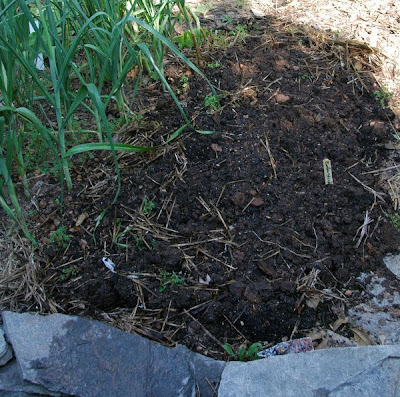
The soil in my vegetable beds work hard, so I'm trying to add LOTS of homemade compost (rather than commercial) at each rotation, as clearly I'm not replenishing my beds as much as they might need. A Thai eggplant planted in a container filled with this compost is huge, the biggest eggplant I've ever grown, witness to the power of nutrients! I'll have to see if the plant produces many fruits. I did see a tomato-sized eggplant last fall (the plant), growing in a large container in a Portland urban garden -- whoa! I'm not sure any of mine will get that big.
And I really should think about preserving the harvest, too (wait, I'm still determined to enjoy the process) -- Barbara Damrosch in her revised Garden Primer talks about freezing whole tomatoes, then rinsing off the skins in hot water before using them in sauces in the winter. That's my idea of a great approach.
We've had a nice bit of rain today, after some unusually hot weather that's now moderated, so it's a good time to put out more summer squash, beans, and a few new heirloom tomato transplants that I acquired last weekend.
I also thought I'd experiment sowing some more seeds of specialty peppers (Corno di Toro, Ashe County Pimento, Numex, Sweet Red Cherry) and tomatoes (Black Russian and Super Marzano hybrid) to transplant later on. Peppers do their best in the warm days of fall here, especially if summer turns out to be especially hot. And tomatoes will keep growing until whenever frost comes.
I'll have the potato beds to swap out, too, probably in the next couple of weeks. I've already harvested some new potatoes around the edges, but will wait until the shoots start dying back to harvest the rest.
The soil in my vegetable beds work hard, so I'm trying to add LOTS of homemade compost (rather than commercial) at each rotation, as clearly I'm not replenishing my beds as much as they might need. A Thai eggplant planted in a container filled with this compost is huge, the biggest eggplant I've ever grown, witness to the power of nutrients! I'll have to see if the plant produces many fruits. I did see a tomato-sized eggplant last fall (the plant), growing in a large container in a Portland urban garden -- whoa! I'm not sure any of mine will get that big.
Labels:
eggplant,
heirloom tomatoes,
natural gardening,
summer squash,
tomatoes
Wednesday, June 3, 2009
A huge butterfly weed
I thought this butterfly weed (Asclepias tuberosa) was huge last year, and ruthlessly rooted out stalks and roots, transplanting them elsewhere, trying to get every bit. This was last year's post. (Uh, it's supposed to be hard to transplant because of the 'taproot'.) I had heeled in a seedling plant some years ago without thinking about it much -- hmmm.This is the main vegetable garden, after all. Notice the trellis with beans next to it!
But clearly it has a strong survival mode, and I've just encouraged it (along with decent rainfall and nutrients added in adjacent spots via compost).
It's currently a magnet for butterflies, honeybees, and bumblebees.
Tuesday, June 2, 2009
Harvesting garlic and garlic scapes
I started harvesting garlic this morning, sorting out some to eat fresh and others to dry. I ended up doing this first small harvest (planted in late November) backwards perhaps (you're supposed to dry the smaller heads and eat the larger ones fresh, according to one reference). And I cleaned the outermost leaves (there was lots of soil sticking to the heads), not normally recommended. So I'll plan on using this first batch early. Last year's harvest was such a success that I'm anticipating garlic for some months to come!
Some of my garlic patches are definitely ready to harvest, judging by leaf dieback (and depending on the variety), other patches need a bit more time. You're supposed to judge by the numbers of brown leaves, with variation depending on whether it's softneck or hardneck.
In practice, this is harder than it seems. But happily, garlic is a forgiving crop, and delicious at any stage. (Any sort of freshly-harvested - that is, green garlic - is fabulous, in my opinion).
If the stalk has tipped over, I definitely harvest it, and if it looks pretty brown (in terms of leaves), ditto. And then I tie up bunches to dry in the garden shed for 2 to 3 weeks (it doesn't take long in our warm climate).
I had bought a bunch of garlic scapes at a tailgate market in the mountains over the weekend -- they were quite tasty, although not as ethereal as some reports would suggest. Interestingly, garlic scapes are largely produced by hard-neck (rocambole) garlics, which in warmer areas, we don't grow as much. So, no wonder my largely soft-neck garlics don't normally produce them (I certainly hadn't noticed them before hearing about them on KCRW's Good Food (a favorite podcast from Southern California accessed via iTunes) and reading about them in various other places.
But I'll be harvesting a few more of my garlic scapes in the next week or so, as they produce a curled flower stalk.
Happily, this year, I actually have copper markers with the varieties marked, so I can keep track of what's what. In previous years, my wooden labels, marked with pencil, indelible ink, or permanent markers, etc. ended up providing no clues as to variety by the time harvest came around. I'm not all that concerned about varieties (all garlic is good), and frankly it's hard for me to distinguish between varieties, except for size of plants and heads, and reddishness of skins in some. But it's nice to TRY to keep track of how different sorts did.
Some of my garlic patches are definitely ready to harvest, judging by leaf dieback (and depending on the variety), other patches need a bit more time. You're supposed to judge by the numbers of brown leaves, with variation depending on whether it's softneck or hardneck.
In practice, this is harder than it seems. But happily, garlic is a forgiving crop, and delicious at any stage. (Any sort of freshly-harvested - that is, green garlic - is fabulous, in my opinion).
If the stalk has tipped over, I definitely harvest it, and if it looks pretty brown (in terms of leaves), ditto. And then I tie up bunches to dry in the garden shed for 2 to 3 weeks (it doesn't take long in our warm climate).
I had bought a bunch of garlic scapes at a tailgate market in the mountains over the weekend -- they were quite tasty, although not as ethereal as some reports would suggest. Interestingly, garlic scapes are largely produced by hard-neck (rocambole) garlics, which in warmer areas, we don't grow as much. So, no wonder my largely soft-neck garlics don't normally produce them (I certainly hadn't noticed them before hearing about them on KCRW's Good Food (a favorite podcast from Southern California accessed via iTunes) and reading about them in various other places.
But I'll be harvesting a few more of my garlic scapes in the next week or so, as they produce a curled flower stalk.
Happily, this year, I actually have copper markers with the varieties marked, so I can keep track of what's what. In previous years, my wooden labels, marked with pencil, indelible ink, or permanent markers, etc. ended up providing no clues as to variety by the time harvest came around. I'm not all that concerned about varieties (all garlic is good), and frankly it's hard for me to distinguish between varieties, except for size of plants and heads, and reddishness of skins in some. But it's nice to TRY to keep track of how different sorts did.
Labels:
garlic,
garlic varieties,
natural gardening
Monday, June 1, 2009
More about gardens and gardening
It's always nice to enjoy and observe other gardens -- I find it endlessly fascinating to see how people create (or don't) the spaces around them.
But, I'm also being reminded that gardening itself is something that I love, too. The process of planting, nurturing, creating is something I miss, when I'm away.
I found myself visiting a nursery yesterday afternoon ( a very nice one, too) just to check them out and came back with several bird feeders for the mountains (hummingbird, thistle, sunflower, and suet) and a deck support for two of them. Hmmm.
There WAS a lot of garlic in the Asheville community garden that I'm checking periodically, but oddly, there have been no tomatoes or peppers planted yet. Some winter squash has appeared and there are lots of potatoes, so maybe folks are waiting for totally warm night-time weather. It was chilly at night over the last few day, in the upper 40's, not appreciated by tomatoes, peppers, or eggplant.
It'll be interesting to see what's planted in the next few weeks.
But, I'm also being reminded that gardening itself is something that I love, too. The process of planting, nurturing, creating is something I miss, when I'm away.
I found myself visiting a nursery yesterday afternoon ( a very nice one, too) just to check them out and came back with several bird feeders for the mountains (hummingbird, thistle, sunflower, and suet) and a deck support for two of them. Hmmm.
There WAS a lot of garlic in the Asheville community garden that I'm checking periodically, but oddly, there have been no tomatoes or peppers planted yet. Some winter squash has appeared and there are lots of potatoes, so maybe folks are waiting for totally warm night-time weather. It was chilly at night over the last few day, in the upper 40's, not appreciated by tomatoes, peppers, or eggplant.
It'll be interesting to see what's planted in the next few weeks.
Labels:
natural gardening
Subscribe to:
Posts (Atom)